

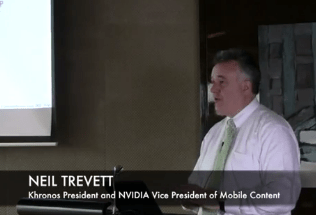
 The Khronos Group gave some talks on their technologies in Shanghai China on the 17th of March 2012. Neil Trevett did some interesting remarks on the position of NVidia on OpenCL I would like to share with you. Neil Trevett is both an important member of Khronos and employee of NVidia. To be more precise, he is the Vice President Mobile Content of NVidia and the president of Khronos. I think we can take his comments serious, but we must be very careful as these are mixed with his personal opinions.
Regular readers of the blog have seen I am not enthusiastic at all about NVidia’s marketing, but am a big fan of their hardware. And exactly I am very positive they are bold enough in the industry to position themselves very well with the fast-changing markets of the upcoming years. Having said that, let’s go to the quotes.
All quotes were from this video. Best you can do is to start at 41:50 till 45:35.
At 44:05 he states: “In the mobile I think space CUDA is unlikely to be widely adopted“, and explains: “A party API in the mobile industry doesn’t really meet market needs“. Then continues with his vision on OpenCL: “I think OpenCL in the mobile is going to be fundamental to bring parallel computation to mobile devices” and then “and into the web through WebCL“.
Also interesting at 44:55: “In the end NVidia doesn’t really mind which API is used, CUDA or OpenCL. As long as you are get to use great GPUs“. He ends with a smile, as “great GPUs” refers to NVidia’s of course. 🙂
At 45:10 he puts NVidia’s plans on HPC, before getting back to : “NVidia is going to support both [CUDA and OpenCL] in HPC. In Mobile it’s going to be all OpenCL“.
At 45:23 he repeats his statements: “In the mobile space I expect OpenCL to be the primary tool“.


 Say you have a device which is extremely good in numerical trigoniometrics (including integrals, transformations, etc to support mainly Fourier transforms) by using massive parallelism. You also have an optimised library which takes care of the transfer to the device and the handling of trigoniometric math.


 With the launch of twitter-channel
 There is a lot going on at the path to GPGPU 2.0 – the libraries on top of OpenCL and/or CUDA. Among many solutions we see for example Microsoft with C++ AMP on top of DirectCompute, NVidia (and more) with OpenACC, and now
 We zoom into the slower bus-speeds. So all the good stuff is at the left and all buses to avoid are on the right. What should be clear is that a read from or write to a SSD will make the software very slow if you use write-trough instead of write-back.
 Does your computer have OpenCL-capable hardware? Read on and find out if your computer is compatible…


 HTML5 has the future, now Flash and Silverlight are abandoning the market to make the way free for HTML5-video. There is one big problem and that is that it is hard to protect the content – before you know the movie is on the free market. DRM is only a temporary solution and many times ends in user-frustration who just want to see the movie wherever they want.

 Typos are a programmers worst nightmare, as they are bad for concentration. The code in your head is not the same as the code on the screen and therefore doesn’t have much to do with the actual problem solving. Code highlighting in the IDE helps, but better is to use the actual OpenCL compiler without running your whole software: an Online OpenCL Compiler. In short is just an OpenCL-program with a variable kernel as input, and thus uses the compilers of Intel, AMD, NVidia or whatever you have installed to try to compile the source. I have found two solutions, which both have to be built from source – so a C-compiler is needed.


 In the series


