General articles on technical subjects.

Winning demo of Tokyo Demo Fest 2013 uses OpenCL

flagThe Tokyo Demo Fest 2013 is one of the many demo-parties around the globe. At such parties is where great programmers meet great artists and show off what came out of their collaborations.

The winner of this year used OpenCL to compute real-time procedurally generated geometries. For the rest C++, OpenGL and Gamemonkey Script was used.

Tech features: curl noise, volumetric textures, Perlin noise, mesh deformations, HDR/bloom, film grain, fractals, Hermite splines, Tweens and quaternion iridescent particles.

The creator, Tokyo-based Eddie Lee, has done more projects – be sure to visit his homepage. I hope more demosceners start using the power of OpenCL to get more out of their demo’s.

Do you see where below kernel is used? Hint: check the other videos of Eddie.

__kernel void curlnel( 
                      __read_only image3d_t volume,  
                      sampler_t volumeSampler,  
                      __global float4 *output,  
                      float speed 
                      ) 
{ 
    uint index = get_global_id(0); 
    uint numParticles = get_global_size(0); 
    float indexNormalized = (float)index/numParticles; 

    // read from 3D texture 
    float4 vertData = output[index]; 

    float3 samplePos = vertData.s012; 
    samplePos = samplePos+(float3)(0.5f); 

    float4 voxel = (read_imagef(volume, volumeSampler, 
                   (float4)(samplePos,1.0f))); 

    vertData.s012 += voxel.xyz*speed; 

    output[index] = vertData; 
}

According to GPUVerify (see previous post) the line starting with “float4 voxel” has an error.

Verify your OpenCL and CUDA kernels online for race conditions

gpuverifyGPUVerify is a tool for formal analysis of GPU kernels written in OpenCL and CUDA. The tool can prove that kernels are free from certain types of defect, such as data races and bugs. This is quite useful feedback for any GPU-programmer.

Below you find a online version of the tool (please don’t break it!). Play around and test your kernels. Be aware the number of groups is the global worksize divided by local worksize.

For demo-purposes some values have been pre-filled with a simple kernel – press “Check my OpenCL kernel” to find the results. Did you expect this from this kernel? Can you explain the result?

After the LEAP-conference I’ll extend this article – till then I’m too time-limited. For now I wanted to share the online version with you, especially with the people who will attend the tutorial at LEAP. Be sure to check out the GPUVerify website and paper to learn more about this fantastic tool! Continue reading “Verify your OpenCL and CUDA kernels online for race conditions”

OpenCL error codes (1.x and 2.x)

computer-says-no
Little Britain: “Compu’er says no”. (links to Youtube movie)

Knowing all errors by heart is good for quick programming, but not always the best option. Therefore I started to create a full list with extra info, taken from cl.h and the reference documentation.

The problem with many error-codes is that they are sometimes context-dependent and then become quite useless in helping the programmer out. Also some drivers return different error-codes. Notice also that different errors are given per OpenCL-version for the same function. If you find problems, help make OpenCL better and give feedback.

Want it on your wall? You can easily copy these two tables into Excel or alike software and print it out.

Continue reading “OpenCL error codes (1.x and 2.x)”

ERSA-NVIDIA award for “Best Young Entrepreneur”

ersa-logoStreamHPC supports the ERSA conference, 22-25 July in Las Vegas. At that conference there will be an award given to “Best Young Entrepreneur” and I’d like you to send in a proposal. The winner gets an NVIDIA Tesla K20!

Young entrepreneurs and academics with a great product/project are invited to present their solution. As the event draws around 2000 people, you get the attention needed to show-case your new company or research-group. Your solution does not need to be based on FPGAs or GPUs, as long as Von Neumann’s architecture is not in it.

Read the information below or directly go to the ERSA-NVIDIA awards-homepage.
“Von Neumann’s architecture lasted for 75 years.”
That genius can no longer lead us into the new age of computing that is upon us. This competition seeks to acknowledge those pioneers that are helping to build the new computing landscape”

Submission of Proposals for ERSA-NVIDIA award Candidates
Deadline: 6 May 2013 31 May 2013 – extended deadline!
Send proposals to org@ersaconf.org

The Award is devoted for entrepreneurs developing tools, advanced technologies and opportunities for supporting applications, both academic and commercial, across broad area of high-performance, embedded systems implemented as multicore systems and reconfigurable heterogeneous parallel processing systems.

The Award Committee includes:

Leading Universities

  •  Stanford University, USA, Prof. Michael Flynn
  •  Imperial College London, UK, Prof. Wayne Luk
  • Karlsruhe Institute of Technology, Germany, Prof. Joerg Henkel
  • Keio University, Japan, Prof. Hideharu Amano
  • Shanghai Jiao Tong University, China, Prof. Simon See

Leading Companies (tentative list):

  • NVIDIA, Can Ozdoruk, Product Manager
  • Altera, Steve Casselmanm, Principal Engineer
  • National Instruments, Hugo Andrade, Principal Architect

For more info go to: http://ersaconf.org/awards/

If you have any question, just ask them in the comments or send us an email.

12-14 June: OpenCL Training Amsterdam

From 12 to 14 June StreamHPC will give a 3-day course in OpenCL (was 3 to 5 June). Here you will learn how to develop OpenCL-programs.

A separate ticket for only the first day can be bought, as then will be a crash-course into OpenCL. Module basics.

The second and third day will all about parallel-algorithm design, optimisation and error-handling. Module optimisation with several new subjects added.

The last part of the third day is reserved for special subjects, as requested by the attendees. Continue reading “12-14 June: OpenCL Training Amsterdam”

Scaling mobile GPUs to 1000 GFLOPS

arm_mali_cover_151112297646_640x360On the 20th of April 2013 there was an interesting discussion between Jan Gray and David Kanter. Jan is a specialist in C++ and FPGAs (twitter, homepage). David is a specialist in CPU and GPU architectures (twitterhomepage). Both know their ways well in the field of semiconductors. It is always a joy to follow their short discussions when they happen, but there was something about this one that made me want to share it with special attention.

OpenCL on ARM: Growth-expectation of GFLOPS/Watt of mobile GPUs exceeds Moore’s law. That’s incredible!

Jan Gray: .@OpenCLonARM GFLOPS/W more a factor of almost-over Dennard Scaling. But plenty of waste still to quash. http://www.fpgacpu.org/papers/Gray_AutumnOfMooresLaw_SingularityUniversity_11-06-23.pdf

Jan Gray‏: .@openclonarm Scratch Dennard tweet: reduced capacitance of yet smaller devices shd improve GFLOPS/W even as we approach end of Vdd scaling.

David Kanter: @jangray @OpenCLonARM I think some companies would argue Vdd scaling isn’t dead…

Jan Gray: @TheKanter @openclonarm it’s not dead, but slowing, we’ve gone from 5V to 1V (25x power savings) and have maybe several hundred mVs to go.

David Kanter: @jangray I reckon we have at least 400mV, so ~2X; slower than ideal, but still significant

Jan Gray: @TheKanter We agree, I think.

David Kanter: @jangray I suspect that if GPU scaling > Moore’s Law then they are just spending more area or power; like discrete GPUs in the last decade

David Kanter: @jangray also, most positive comment I’ve heard from industry folks on mobile GPU software and drivers is “catastrophically terrible”

Jan Gray: @TheKanter Many ways to reduce power, soup to nuts. For ex HMC DRAM on interposer for lower energy signaling. I’m sure many tricks to come.

In a nutshell, all the reasons they think mobile GPUs can outpace Moore’s law while staying under a certain power-usage.

It needs some background-info, so let’s start the background of the first tweet, and then explain what has been said. Continue reading “Scaling mobile GPUs to 1000 GFLOPS”

Q&A with Adrien Plagnol and Frédéric Langlade-Bellone on WebCL

WebCL_300WebCL is a great technique to have compute-power in the browser. After WebGL which gives high-end graphics in the browser, this is a logical step on the road towards the browser-only operating system (like Chrome OS, but more will follow).

Another way to look at technologies like WebCL, is that it makes it possible to lift the standard base from the OS to the browser. If you remember the trial of Microsoft’s integration of Internet Explorer, the focus was on the OS needing the browser for working well. Now it is the other way around, but it can be any OS. This is because the push doesn’t come from below, but from above.

Last year two guys from Lyon (South-France) got quite some attention, as they wrote a WebCL-plugin. Their names: Adrien Plagnol and Frédéric Langlade-Bellone. Below you’ll find a Q&A with them on WebCL. Enjoy! Continue reading “Q&A with Adrien Plagnol and Frédéric Langlade-Bellone on WebCL”

LEAP-conference call for papers

921752_m
Building bridges in a new industry

Embedded processors always have had the focus on low-energy. Now a combination of Moore’s law, the frequency-wall and multi-processor developments have made it possible for these processors to compete in completely new market segments. Most notable due to impressive advancements in graphics IP.
We are now looking at four groups who are interested in learning from each other:

  • The embedded processor market
  • The FPGA market
  • The HPC and server market
  • The GPGPU market

And answer the question: how can we get more out of low-energy processors by looking at other industries?

The goal of the LEAP conference is to bring these three groups together. Creating the windows to each other and paving roads over the newly constructed bridges. This makes it one of its kind. Half of the conference is focused on quality information sharing and the other half on networking. For more information, check the website of the LEAP-conference. StreamHPC is a co-organiser.

Call for papers is now open! Programme is filled!

Continue reading “LEAP-conference call for papers”

OpenCL Basics: Flags for the creating memory objects

flagsIn OpenCL large memory objects, residing in the main memory of the host or the global memory at the accelerator/GPU, need special treatment. First reason is that these memories are relatively slow. Second reason is that the most times serial copy of objects between these two memories take time.

In this post I’d like to discuss all the flags for when creating memory objects, and what they can do to assist in this special treatment.

This is explained on this page of clCreateBuffer in the specifications, but I think it is not really clear. The function clCreateBuffer (and the alike functions for creating images, sub-buffers, etc) suggests that you create a special OpenCL-object to be given as argument to the kernel. What actually happens is that space is made available in main memory of the accelerator and optionally a link with host-memory is made.

The flags are divided over three groups: device access, host access and host pointer flags.

Continue reading “OpenCL Basics: Flags for the creating memory objects”

X86-workstation buying guide for OpenCL developers, Q1 2013

Curved iMac has your back…
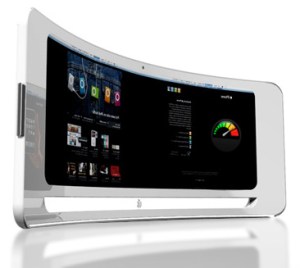
Nuno Teixeira designed a large curved monitor in 2008 and assumed it would never be made. For a “few” thousand dollar NEC offers one to you right now. Also Samsung and LG have announced several new curved TVs at CES 2013 (with hdmi-port). We only need a workstation to go with it, where this blog-article might come in handy.

Important: this article was written before Intel “Haswell” and AMD “Richland” architectures came out.

So you want to start developing for OpenCL? When you focus on developing OpenCL for X86, you have these three options: CPUs, GPUs and CPUs with and embedded GPU. This article is for you and represents the current state of hardware – if you want the best hardware for your specific algorithm, the below information is probably not sufficient.

In 2013 we focus on 3 groups: servers/cloud (FirePro, Tesla, XeonPhi), workstations (discussed here), low-power devices (SoCs) and special accelerators (FPGAs and DSPs). This article does not discuss high-end accelerators of a few thousands of Euro, which are laid out in here.

Before reading on, you need to set the goal for your workstation.

  • If you want to learn the basics of OpenCL-programming, first check if your current machine has OpenCL-support.
  • If you need more processing power, be sure you select the right hardware for the job. Don’t buy the most expensive hardware (FirePro, Tesla or XeonPhi), but take your time to find out which hardware supports your algorithms best. Feel free to ask us.
  • If you want to make sure your software works on various types of accelerators, you can choose between:
    • swapping PCIe-cards – disadvantage is the drivers-hazzle and time-consumption.
    • more accelerators in one machine – disadvantage is that only GPU 1 can do OpenGL/DirectX.
    • identical machines with different accelerators – disadvantage is the price.
  • If you want to focus on multi-GPU development, you need:
    • or enough power-supply and the motherboard supports many lanes,
    • or buy a videocard with two GPUs.

This article has the goal to help you with buying a good machine for OpenCL-development. Prices are of January 2013. If you think I make the wrong suggestions, please give feedback via the comments.

My contacts at various companies can tell: I want to stay independent no matter what. No deals have been made nor was there any outside influence, except the friendly people of the local computer shops. I was surprised I ended up with suggestion so much AMD hardware, that I felt quite uncomfortable with it – I finally decided to keep to my first conclusions and leave the comments completely open.

Continue reading “X86-workstation buying guide for OpenCL developers, Q1 2013”

The entanglement of Bitcoins and compute-capabilities

Every now and then I read stories on Bitcoins (Wikipedia-article), as GPUs are used a lot to “mine” Bitcoins. They have some extensive benchmarks, and also their discussions giving me insights in specific parts of accelerators like GPUs. Also is this group very upwards if it comes to accepting new techniques. Today something changed: they are a bank now. One of the thoughts I had with this, I’d like to share with you.

If you look at various types of currencies, you see they all have various goals (trade, power, resources, energy, properties, etc). The inequality and differences are even more important than the amount. Various currencies are entangled to a certain goal or resource, but there is nothing entangled strongly to technology. Here is where Bitcoins come in…

Bitcoins are entangled with compute-power – a current benchmark for technological progress.

In this article I’d like to share how the tech-economy and Bitcoins are entangled, seen from the perspective of computing. I left out a lot of the “rules of economy” and hope you can put these in – the below text is just to guide you through the thought-process only. Disagreement is only good – as we learn all from it.

Continue reading “The entanglement of Bitcoins and compute-capabilities”

The OpenCL power: offloading to the CPU (AVX+SSE)

Say you have some data that needs to be used as input for a larger kernel, but needs a little preparation to get it aligned in memory (small kernel and random reads). Unluckily the efficiency of such kernel is very low and there is no speed-up or even a slowdown. When programming a GPU it is all about trade-offs, but one trade-off is forgotten a lot (especially by CUDA-programmers) once is decided to use accelerators: just use the CPU. Main problem is not the kernel that has been optimised for the GPU, but all supporting code (like the host-code) needs to be rewritten to be able to use the CPU.

Why use the CPU for vector-computations?

The CPU has support for computing vectors. Each core has a 256 bit wide vector computer. This mean a double4 (a vector of 4 times a 64-bit float) can be computed in one clock-cycle. So a 4-core CPU of 3.5GHz goes from 3.5 billion instructions to 14 billion when using all 4 cores, and to 56 billion instructions when using vectors. When using a float8, it doubles to 112 billion instructions. Using MAD-instructions (Multiply+Add), this can be doubled to even 224 billion instructions.

Say we have this CPU with 4 core and AVX/SSE, and the below code:

int* a = ...;
int* b = ...; 
for (int i = 0; i < M; i++)
   a[i] = b[i]*2;
}

How do you classify the accelerated version of above code? A parallel computation or a vector-computation? Is it is an operation using an M-wide vector or is it using M threads. The answer is both – vector-computations are a subset of parallel computations, so vector-computations can be run in parallel threads too. This is interesting, as this means the code can run on both the AVX as on the various codes.

If you have written the above code, you’d secretly hope the compiler finds out this automatically runs on all hyper-threaded cores and all vector-extensions it has. To have code made use of the separate cores, you have various options like normal threads or OpenMP/MPI. To make use of the vectors (which increases speed dramatically), you need to use vector-enhanced programming languages like OpenCL.

To learn more about the difference between vectors and parallel code, read the series on programming theories, read my first article on OpenCL-CPU, look around at this site (over 100 articles and a growing knowledge-section), ask us a direct question, use the comments, or help make this blog tick: request a full training and/or code-review.

Continue reading “The OpenCL power: offloading to the CPU (AVX+SSE)”

AMD positions FirePro S10000 against both TESLA K10 (and K20)

During the “little” HPC-show, SC12, several vendors have launched some very impressive products. Question is who steals the show from whom? Intel got their Phi-processor finally launched, NVIDIA came with the TESLA K20 plus K20X, and AMD introduced the FirePro S10000.

This card is the fastest card out there with 5.91 TFLOPS of processing power – much faster than the TESLA K20X, which only does 3.95 TFLOPS. But comparing a dual-GPU to a single-GPU card is not always fair. The moment you choose to have more than one GPU (several GPUs in one case or a small cluster), the S10000 can be fully compared to the Tesla K20 and K20X.

The S10000 can be seen as a dual-GPU version of the S90000, but does not fully add up. Most obvious is the big difference in power-usage (325 Watt) and the active cooling. As server-cases are made for 225 Watt cooling-power, this is seen as a potential possible disadvantage. But AMD has clearly looked around – for GPUs not 1U-cases are used, but 3U-servers using the full width to stack several GPUs.

Continue reading “AMD positions FirePro S10000 against both TESLA K10 (and K20)”

Intel’s answer to AMD and NVIDIA: the XEON Phi 5110P

NOTE: there are many contradicting sources out there, so there are mistakes in this article. Please give me feedback via twitter, mail or comments, so all the info can be completed.

Yes, another post in the answer-to series. At SC12 Intel tries to steal away the show from the Tesla K20 and FirePro S10000.

After two years of waiting Intel finally comes with an accelerator-card: the Xeon Phi. Compare it if NVIDIA would have skipped the GTX 200 series and now has presented the GTX 500 series. Or maybe even the GTX 600 series – we cannot tell yet.

The Phi is not a compute-card as we know it. As you cannot do a 1-to-1 comparison between AMD GCN architecture and NVIDIA Kepler, neither can be easily compared to the Phi. But this article should give an idea on where it is positioned.

Continue reading “Intel’s answer to AMD and NVIDIA: the XEON Phi 5110P”

NVIDIA’s answer to FirePro S9000: the TESLA K20

Two months ago I wrote about the FirePro S9000 – AMD’s answer to the K10 – and was already looking forward to this K20. Where in the gaming world, it hardly matters what card you buy to get good gaming performance, in the compute-world it does. AMD presented 3.230 TFLOPS with 6GB of memory, and now we are going to see what the K20 can do.

The K20 is very different from its predecessor, the K10. Biggest difference is the difference between the number of double precision capability and this card being more powerful using a single GPU. To keep power-usage low, it is clocked at only 705MHz compared to 1GHz of the K10. I could not find information of the memory-bandwidth.

ECC is turned on by default, hence you see it presented having 5GB. No information yet if this card also has ECC on the local memories/caches.

Continue reading “NVIDIA’s answer to FirePro S9000: the TESLA K20”

All OpenCL SDKs now in our Knowledge Base

For who hasn’t seen the latest addition to our knowledge base, we have added a list of all (almost) available OpenCL-SDKs. You can find it in the menu under “Knowledge Base” -> “SDKs…“.

This list shows how important OpenCL is getting, as developers now can write compute-intensive parallel software on CPUs, GPUs, ARM-based accelerators and even FPGAs. This growth of OpenCL-devices is very exciting and important news, and that’s why it has got its own section on the site.

The the current list is (in random order):

Currently looking into:

  • Intel Xeon Phi
  • Nintendo Wii U dev
  • Sony Playstation 4 Orbis
  • Vivante
  • Xilinx
  • NVidia GPUs
  • Qualcomm

The SDK of NVIDIA is on the second list, what you maybe did not unexpected. We have to wait until they have put their official statement on what they are going to do with CUDA and OpenCL.

While you are there, also check the other parts of the Knowledge Base:

  • What is… -> Explanations of terminology. Put your requests in a comment.
  • Event&Talks -> A list of events which StreamHPC attends, give talks at and helps organise. Interesting for both managers and engineers.
  • Self Study – The part of the site most visited after the blog. This is for the engineers who want to start learning programming GPUs.

This section will be updated and extended continuously with information not available anywhere else.

StreamHPC has been in the OpenCL business since 2010 as one of the few. We have been the most visible and known OpenCL-specialist ever since.

Scientific Visualisation of Molecules

In many hard sciences focus is on formulas and text, whereas images are mainly graphs or simplified representations of researched matters. Beautiful visualisations are mainly artist’s impressions in popular media targeting hobby-scientists. When Cyrille Favreau made the first good-working version of his real-time GPU-accelerated raytracer, he saw potential in exactly this area: beautiful, realistic visualisations to be used in serious science. This resulted in software called IPV.

He chose to focus on rendering molecules of proteins and this article discusses raytracing in molecular sciences, while highlighting the features of the software.

This project has been discussed on GPU Science, but this article looks at the the software from a slightly different perspective. If you don’t want to know how the software works and what it can do, scroll down for a download-link.

Raytracing introduction

Continue reading “Scientific Visualisation of Molecules”

Targetting various architectures in OpenCL and CUDA

“Everything that *is* makes up one single world; but not everything is alike in this world” – Plato

The question we aim to answer in this post is: “How to do you make software that performs on several platforms?”.

Note: This article is not fully finished – I’ll add more information during the coming months. It’s busy here!

Even in many Java-code you’ll find hard-coded filename-delimiters in the file-names, which then work on one OS only. Portability is a problem that exists in various aspects of programming. Let’s look at some of the main goals software can have, and which portability-problems they have.

  • Functionality. This is the minimum requirement. Once a function is decided, changing functionality takes a lot of time. Writing code that is very flexible in requirements is hard.
  • User-interface. This is what one sees and which is not too abstract to talk about. For example, porting software to a touch-device requires a lot of rethinking of interaction-principles.
  • API and library usage. To lower development-time, existing and known APIs and libraries are used. This can work out three ways: separation of concerns, less development-time and dependency. The first two being good architectural choices, the latter being a potential hazard. Changing the underlying APIs is not easy.
  • Data-types. Handling video is different from handling video-formats. If the files can be handles in the intermediate form used by the software, then adding new file-types is relatively easy.
  • OS and platform. Besides many visible specifics, an OS is also a collection of APIs. Not only corporate operating systems tend to think of their own platform only, but also competing standards. It compares a lot to what is described under APIs.
  • Hardware-performance. Optimizing software for a specific platform makes it harder to port to other platforms. This will the main point of this article.

OpenCL is known for not being performance-portable, but it is the best we currently have when it comes to writing code with performance as a primary target. The funny thing is that with CUDA 5.0 it has become clearer that NVIDIA has the problem in their GPGPU-language too, whereas it was used before to differentiate CUDA from OpenCL. Also, CUDA 5.0 has many new features only available on the latest Kepler-GPUs.

Continue reading “Targetting various architectures in OpenCL and CUDA”

OpenCL Videos of AMD’s AFDS 2012

AFDS was full of talks on OpenCL. You missed them, just like me? Then you will be happy that they put many videos on Youtube!

Enjoy watching! As all videos are around 40 minutes, it is best to take a full day for watching them all. The first part is on openCL itself, second is on tools, third on OpenCL usages, fourth on other subjects.

Continue reading “OpenCL Videos of AMD’s AFDS 2012”